


When nonprofits look for funding, grant applications and individual donor campaigns often take centre stage. However, many organizations overlook a massive revenue stream sitting right in front of them: corporate partnerships. Securing corporate support requires a completely different playbook than traditional fundraising—one rooted in mutual benefit, commercial alignment, and professional presentation.
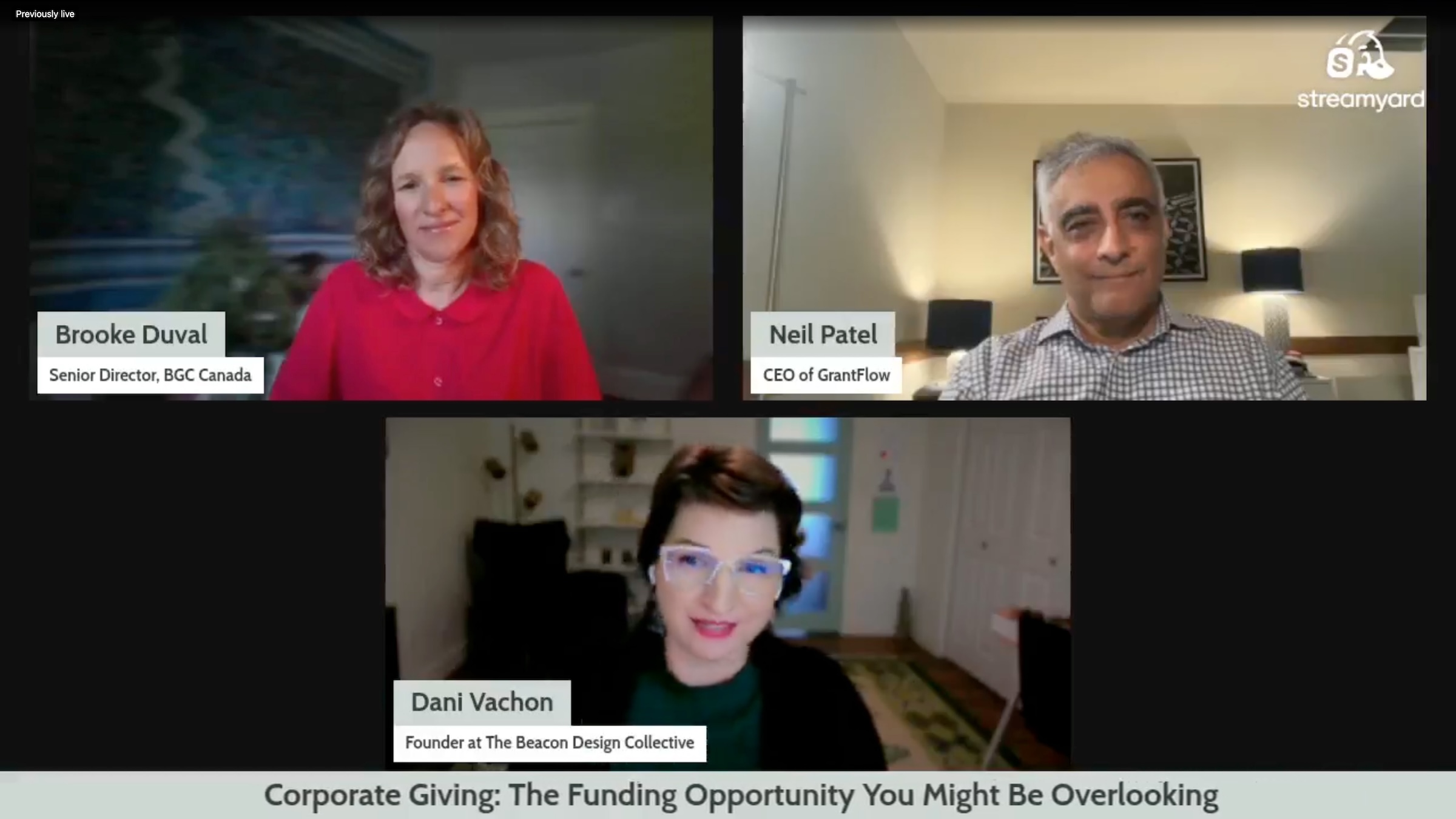
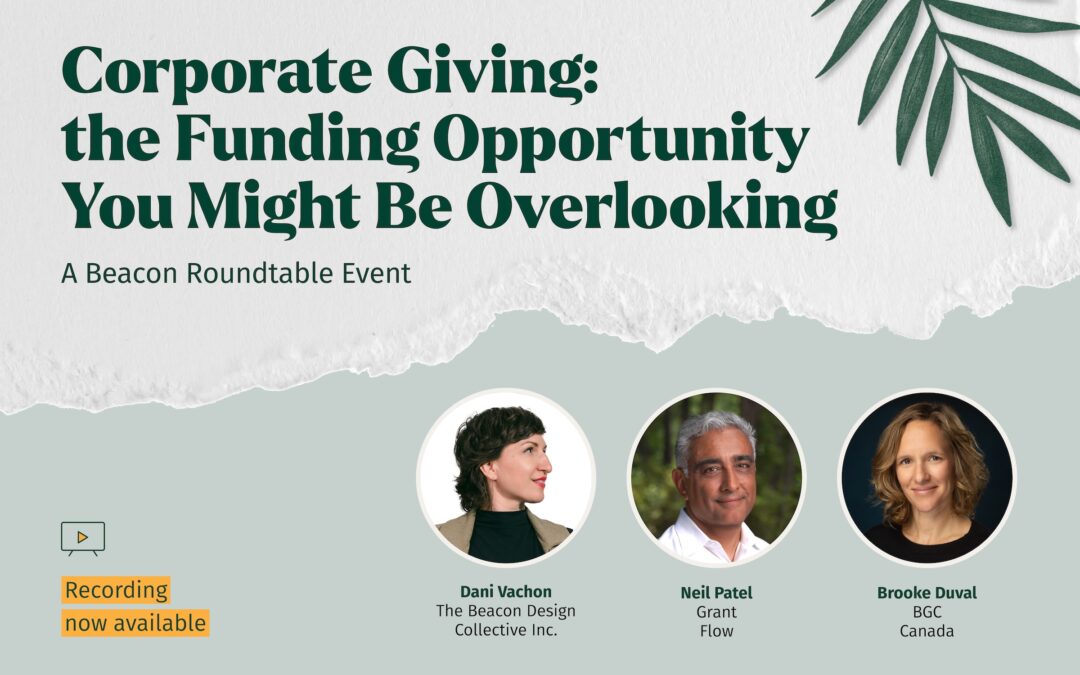
Recently, we hosted the fourth session of our virtual roundtable series, “Corporate Giving: the Funding Opportunity You Might Be Overlooking,” to crack open this playbook. Our panel of experts pulled back the curtain to look at how nonprofits can successfully prospect, pitch, and steward high-value corporate relationships.
The session was led by a seasoned group of sector leaders:
- Dani Vachon and The Beacon Design Collective help purpose-driven organizations build trust and amplify their impact through strategic publication design, branding, and motion graphics.
- Brooke Duval and her team at BGC Canada create life-changing opportunities for children and youth across the country through innovative corporate partnerships.
- Neil Patel and the Grant Flow team empower nonprofits to streamline their fundraising operations and back up their stories with ironclad data.
Here’s a detailed breakdown of the key strategic takeaways from our conversation.
Understanding corporate funding buckets
Before reaching out to a business, it’s vital to recognize that corporate money doesn’t all come from the same place. Dani kicked off the session by outlining the two primary “buckets” of corporate funding: foundation giving and corporate sponsorship.
Foundation giving is driven primarily by corporate goodwill, community impact, and CSR (Corporate Social Responsibility) targets. This pot of money operates purely on altruism, with corporations setting up these foundations focused on long-term systemic improvement and community health, expecting no commercial advantages or transactional marketing returns in exchange for their support.
Corporate sponsorship, on the other hand, comes directly out of a company’s marketing or operations budget. Accordingly, it’s a commercial transaction; corporations expect tangible business benefits in return for their dollars, such as logo placement, brand visibility, or positive public relations. Nonprofits often fail because they pitch a pure marketing sponsorship using the emotional, charity-focused language meant for a foundational grant.
Prospecting and the power of persistence
When launching a corporate outreach campaign, the biggest mistake is reaching out blindly to giant, multinational corporations without a strategic connection. Brooke recommended starting the prospecting phase by looking inward. For instance, nonprofits should audit their own boards, senior volunteers, and staff to uncover warm leads and existing personal connections.
To further cultivate warm leads, Brooke advised building targeted industry lists—identifying the top three companies in sectors like banking, retail, or automotive—and presenting them to the board for potential introductions. Neil added an excellent strategic tip for identifying hidden opportunities: look for companies that have recently experienced a public relations blow or a tarnished reputation in a specific city. These businesses are often actively seeking community partnerships to help rebuild local trust and repair their brand image.
Once prospects are identified, the key to success is relentless follow-up. Brooke shared that cold outreach emails should never include heavy attachments like PDF pitch decks, as these easily trigger corporate spam filters. Instead, use tools like Hunter.io to find direct email addresses, send a short text-only hook, and commit to following up at least five times across multiple channels before assuming a prospect isn’t interested.
Crafting the pitch: balancing heart and head
A successful corporate pitch deck requires a delicate balance of emotional storytelling and hard business metrics—what Neil described as balancing the “heart” and the “head.” A pitch should always lead with the heart, using a powerful narrative or a short video to establish an immediate emotional connection and build affinity for your cause.
However, that emotional hook must immediately appeal to the head. Corporate sponsors need to see data-driven results that align perfectly with their own customer demographics and geographic footprint. They want to know exactly who you serve, where you operate, and how partnering with you will support things like their internal corporate culture or employee retention through volunteerism.
To ensure the pitch lands effectively, format matters just as much as content. Neil stressed that corporate pitches must be concise and mobile-friendly, such as by incorporating bullet points and clear layouts. Corporate decision-makers routinely read pitch decks on their phones while commuting or quickly forward them to internal committees. If your deck is an unreadable, text-heavy PDF, it will get ignored. Brooke also noted that organizations must move away from rigid, templated “gold, silver, platinum” sponsorship packages, opting instead for highly customized activations tailored to the company’s unique marketing goals.
Stewardship and managing performance gaps
Securing the partnership is only the beginning; maintaining it requires consistent, intentional stewardship. Brooke recommended establishing five to eight distinct touchpoints with corporate partners throughout the year. These shouldn’t be requests for more money, but rather value-add interactions such as impact updates, beneficiary success stories, or even sending a note to celebrate the partner’s corporate anniversary.
Genuine gratitude goes a long way. Brooke highlighted that simple acts—like a handwritten thank-you card or a direct message from a program beneficiary—can secure multi-year retention far better than a standard automated email.
But what happens when an activation underperforms or an event doesn’t hit its targets? Neil advised tackling performance gaps with radical honesty. If an initiative falls short, reach out to the corporate partner proactively before they notice the issue themselves. Admit the gap, explain the lessons learned, and immediately offer a “make good”—such as additional digital promotion or a spot in a future campaign—to protect long-term trust.
Visualizing impact for corporate partners
In 2026, corporate partners are demanding clear, tangible “dollar-to-impact” models. Sponsors want to see exactly how their financial contribution translates to real-world change. To this end, Dani highlighted cause-related marketing models, like the famous partnership between Pampers and UNICEF (“one pack equals one vaccine”), as the gold standard for showing mutual, tangible benefits.
In addition, to satisfy corporate stakeholders, nonprofits must learn to translate raw spreadsheets into professional, visual narratives. Dani explained how strategic design can transform dense impact data into digestible visuals:
- Pie charts clearly illustrate proportions of funding allocation.
- Bar graphs show clear year-over-year comparisons of community growth.
- Timelines and infographics map out long-term trends and program milestones.
By replacing walls of text with professional data visualization, you don’t just show that your program works—you prove to corporate executives that your nonprofit operates with the stability, transparency, and professionalism of a top-tier business partner.
Driving long-term value through a shared vision
Unlocking corporate giving isn’t about asking for charity, but rather about building a strategic, mutually beneficial business relationship. By distinguishing between funding buckets, remaining persistent in your outreach, balancing emotion with data, and professionally visualizing your impact, your nonprofit can build sustainable corporate partnerships that scale your mission for years to come.