



Why legacy organizations are losing ground to digital community champions, and how to win back public trust
You may be losing the trust war
When many leaders in the nonprofit or public sector hear the word “influencer,” they picture celebrities pushing fast fashion or detox teas on Instagram. Because of this persistent myth, many organizations write off the creator economy entirely.
But that’s a costly mistake. Today, the best influencers aren’t just digital salespeople. They’re digital community champions: educators, lived-experience advocates, and trusted local voices with fiercely loyal audiences.
Ignoring them comes at a cost. With public trust in legacy institutions, government agencies, and traditional NGOs is eroding faster than ever, we’re living in an era where people are highly skeptical of large organizations and official logos. Instead, they place their trust in individuals.
So if you only rely on your official channels to spread your message, you’re likely losing ground to digital champions who already hold the public’s ear.
How you may be misusing creators
Even when organizations try influencer marketing, they often stumble. If you treat creators like traditional advertising, you’ll waste your budget. Here’s how organizations commonly misuse their digital partners:
- Bleeding money on the “Donate Now” ask: Paying an influencer to stare into a camera and ask their audience for money is the fastest way to burn through your budget. Influencer audiences rarely turn into donors for a cause they just learned about. Instead, aim for low-barrier actions, like signing a petition or joining your email list.
- Preaching to the choir: Your official social media accounts are probably stuck in an echo chamber, seen primarily by people who already follow and agree with you. Without influencers to “rent” new audiences, your cause will remain largely invisible to the outside world.
- The SME trap vs. the translator: Never force an influencer to pretend they’re an expert in your organization’s environmental science or social policy. It feels inauthentic and risks spreading misinformation. Your organization should hold subject matter expertise (SME); the influencer’s job is to translate it, turning your data into stories people will follow. This protects your credibility.
Remember, a well-managed influencer acts as an authentic amplifier, turning your complex mission into an accessible movement that entirely new audiences will want to join.
How to evaluate the right fit
Choosing the wrong partner is a serious liability. When evaluating potential creators, you need to look far beyond their follower count to protect your brand and ensure real-world impact.
- The danger of vanity metrics: Chasing massive follower counts instead of prioritizing micro-influencers often leads to zero real-world mobilization. A celebrity with a million followers might get you likes, but a local advocate with 3,000 highly engaged followers will get people to show up to your town hall. Choose deep, localized trust over vanity metrics.
- Geographic irrelevance: If your conservation NGO operates only in British Columbia, paying for a Toronto-based creator’s audience is a waste of resources. Always ask creators for their audience demographics, so you know their followers actually live where your work happens.
- Inheriting a toxic community: You aren’t just hiring a creator—you’re inviting their community into your digital space. Skip a comment-section audit, and you might accidentally invite internet trolls to your doorstep. Make sure the creator fosters a healthy, constructive dialogue among their followers.
Taking the time to evaluate and select the perfect community champion means you aren’t just buying reach, you’re inheriting a deeply engaged, supportive community who is primed to take meaningful action alongside you.
The dos and don’ts that destroy ROI
Handing your messaging over to a third party requires a strategic leap of faith. Managing that relationship poorly will destroy your return on investment (ROI). Here’s how to navigate the common friction points of creator collaborations.
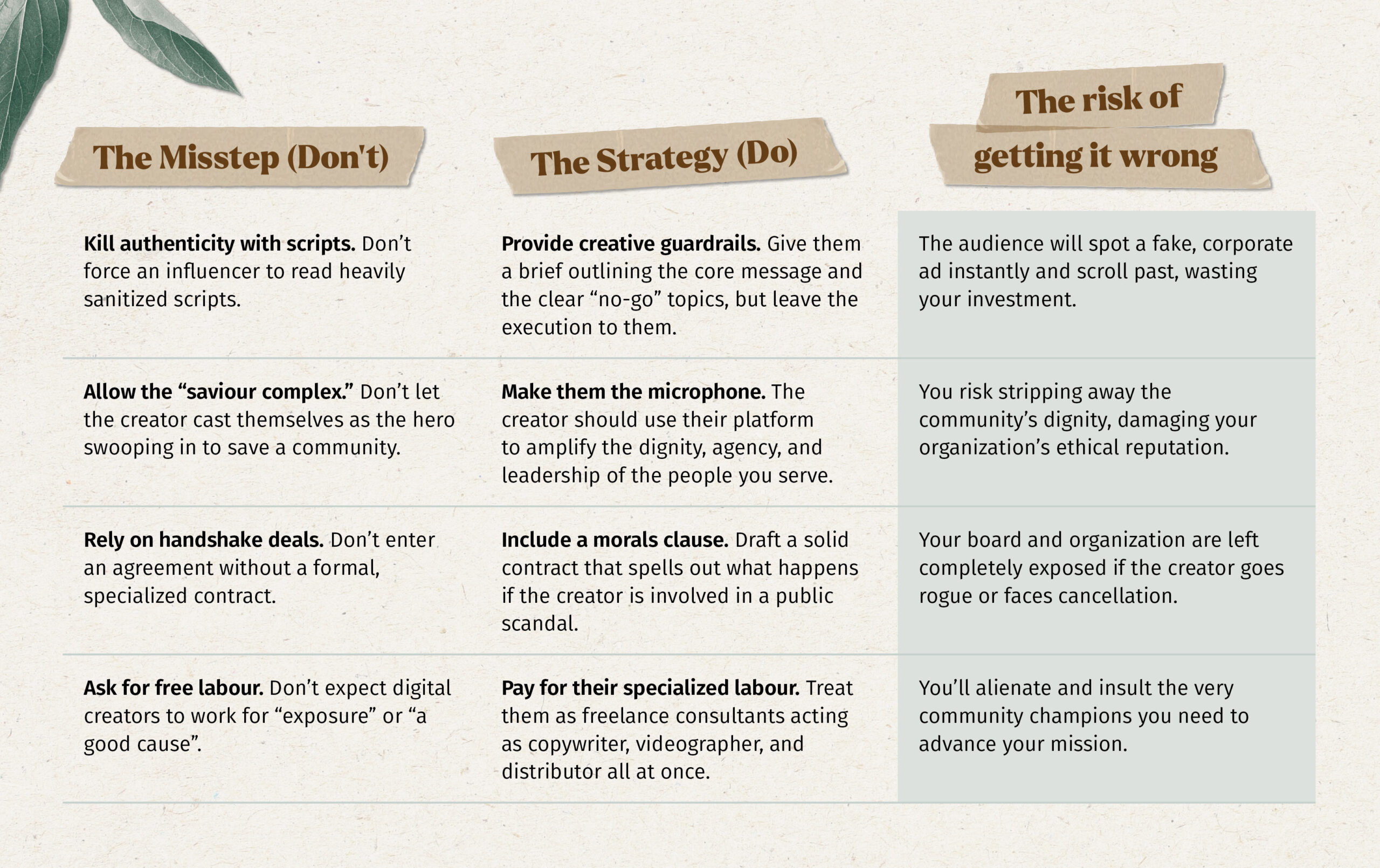
View and download the The Dos and Don’ts That Destroy ROI handout as a PDF here.
The cost of sitting on the sidelines
What happens to nonprofits, NGOs and government agencies that refuse to adapt to the creator economy? They age out of relevance. Their donor base shrinks, their public engagement drops, and their mission stalls.
But when done right, influencer partnerships offer incredible ROI. They don’t just provide fleeting attention. They act as a vital bridge, transferring authentic, localized trust directly into your organization’s ecosystem.
Now what?
The stakes for your organizations are high. Don’t let another initiative launch into an echo chamber. Start by reviewing your upcoming campaigns for this quarter, and identify one specific project where a trusted community champion could help you break through the noise. Partnering with the right creator is about building a bridge between your critical work and the people who care about it. When you embrace these community champions, you stop shouting into the void and start sparking genuine, localized movements that drive your mission forward.
TL;DR: The influencer cheat sheet
A rapid-fire checklist for busy leaders, directors, and communicators ready to launch a creator campaign:
☐ Hire for resonance, not reach. Micro-influencers drive action; massive accounts just drive “likes”.
☐ Give guardrails, not scripts. Tell the influencer what the goal is, but let them use their own voice.
☐ Let them translate; keep the expertise in-house. You’re the expert; they’re the communicator.
☐ Put a morals clause in the contract. Protect your reputation in writing.
☐ Pay them for their specialized labour. Exposure doesn’t pay the bills.